
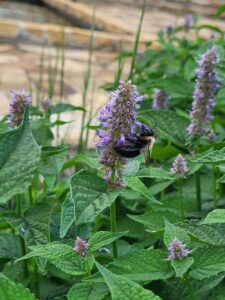
Solitary native bees make up the vast majority of bee species in North America with over 4,000 species and are essential pollinators for both wild ecosystems and agricultural crops. Unlike honeybees, solitary bees do not live in hives or produce honey. Each female builds her own nest, often in soil, wood, or plant stems, and forages for pollen and nectar to provision her young.
Many solitary bee species are pollen specialists, meaning they forage on a narrow range of plants, sometimes a single genus or species. Supporting these bees requires planting a diverse array of native species that bloom throughout the growing season. Here are some examples:
• Asclepias incarnata (Swamp Milkweed): Nectar and pollen for specialist bees like Epeolus and Hylaeus species.
• Monarda fistulosa (Wild Bergamot): Nectar-rich flowers attract mason bees (Osmia spp.) and sweat bees (Augochlora spp.).
• Solidago spp. (Goldenrod): Late‐season blooms that provide critical pollen for mining bees (Andrena spp.) and sweat bees.
• Liatris spicata (Dense Blazing Star): Nectar for long‐tongued bees, including leafcutter bees (Megachile spp.).
• Echinacea purpurea (Purple Coneflower): Supports carpenter bees (Xylocopa spp.) and leafcutter bees.
• Penstemon digitalis (Foxglove Beardtongue): Nectar for a variety of solitary bees including digger bees (Anthophora spp.).
• Collinsonia canadensis (Richweed): Attracts specialist miner bees and provides late‐season forage.